The short version
- What it is: the fee a poker room takes for running the game.
- How it's charged: a slice of each pot (with a cap) in cash games, a fixed fee inside the buy-in in tournaments.
- Why it matters: it comes out of your results whether you win or lose.
- What to check: the percentage, the cap, and anything that hands rake back.
Rake in One Sentence
Rake is the fee a poker room takes for running the game: usually a small slice of each pot in cash games, or a fixed fee added to the buy-in in tournaments.
Think of it as the cover charge at a club. Nobody is billing you for the music. You're paying so the doors stay open, the lights stay on and somebody is behind the bar. In poker, the room is the venue, the software is the dealer (fast, tireless, never needs a break), and the rake is how the whole place pays for itself.
The important bit: you are not playing against the house. You're playing against other players, and the room simply takes a cut for hosting the game.
How Rake Works in Cash Games
In cash games the room takes a percentage of each pot, with a ceiling so enormous pots don't get flattened. Two knobs control everything:
- The percentage. Usually a few per cent of the pot.
- The cap. The most the room will take from any single pot, no matter how big it gets.
Most rooms also follow the golden rule of “no flop, no drop”: if the hand ends before the flop is dealt, there's no rake. Everyone folds to the big blind? The room earns nothing. It only gets paid when a hand actually gets going.
Here's what that looks like with an example structure of 5% rake and a $3 cap (illustrative numbers, real rooms differ):
| Pot size | 5% of the pot | Rake (cap $3) | Winner receives |
|---|---|---|---|
| $10 | $0.50 | $0.50 | $9.50 |
| $40 | $2.00 | $2.00 | $38.00 |
| $60 | $3.00 | $3.00 | $57.00 |
| $200 | $10.00 | $3.00 | $197.00 |
Spot the pattern: once the pot hits the cap, the rake stops growing. That's why big pots are rake-light in percentage terms, and why lower stakes, where pots rarely reach the cap, tend to feel the rake the most.
How Rake Works in Tournaments
Tournaments are simpler: the rake is baked into the buy-in. When you see a buy-in written as $100 + $9, the $100 goes into the prize pool and the $9 goes to the room. The total price is $109.
Illustrative maths: 100 players each pay $109, so $10,900 comes in. $10,000 goes to the prizes and $900 stays with the room. There's no pot-by-pot deduction and no cap. You pay the same fee up front whether you win the whole thing or bust in the first level. The room gets paid either way.
That $9 on a $100 buy-in is a 9% fee. In tournament lobbies you'll hear it called the “fee” or the “juice” more often than “rake”, but it's the same idea: the room's cut for hosting.
One Hand, Start to Finish
Let's follow a single hand at a cash table (same illustrative 5% rake, $3 cap).
Ana and Ben see a flop. They bet, call, raise and call their way to the river. By the end, each has put $30 in the middle, so the pot is $60. Ben shows a flush, Ana shows a pair, and Ben wins.
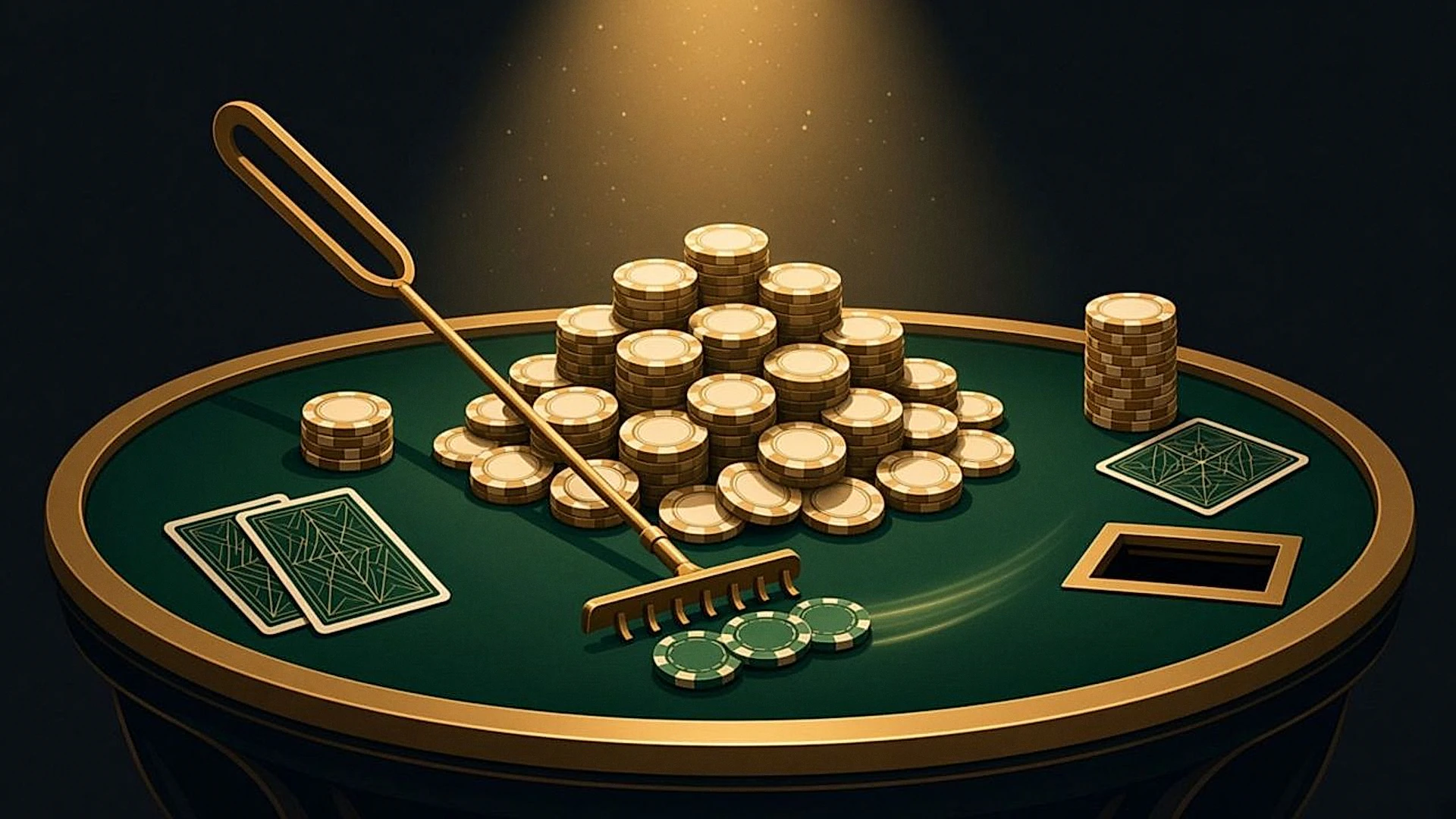
- 5% of $60 is $3, which is exactly the cap, so the room takes $3.
- Ben receives $57.
- Ben's real profit on the hand is $57 − $30 = $27, not $30.
Notice what didn't happen: nobody sent Ben an invoice. The rake is taken out of the pot before it's pushed to the winner, so you never see it as a separate charge. That's exactly why it's so easy to forget about.
And had Ana folded before the flop? Pot raked: $0. No flop, no drop.
What Rake Costs You Over a Month
Percentages and caps are fine, but what does rake actually cost? Let's turn it into a month of play. Feelings off, calculator on.
Imagine a cash game player (illustrative setup, not a benchmark):
- Plays 10,000 hands in the month.
- Plays $0.25/$0.50, so one big blind (bb) = $0.50.
- Would win 6 bb per 100 hands before rake.
- Pays rake equal to 4 bb per 100 hands.
| Measure | Per 100 hands | Over 10,000 hands |
|---|---|---|
| Result before rake | 6 bb ($3) | 600 bb ($300) |
| Rake paid | 4 bb ($2) | 400 bb ($200) |
| What you actually keep | 2 bb ($1) | 200 bb ($100) |
Three things jump out:
- Rake comes out of your results whether you're winning or losing. A player who breaks even before rake is down $200 a month after it.
- Small edges take the biggest hit. In this example the rake eats two-thirds of the profit. That's not a rounding error.
- This is why rake structures matter. The same player in a room with lighter rake keeps more. Which brings us to comparing rooms.
Real rake varies by room, stakes and table size. The numbers above are illustrative only.
Why Poker Rooms Charge Rake
Poker is the odd one out in the gambling world. In most casino games the house plays against you and wins on average. In poker, your opponents are other players, so the room has no stake in who wins any hand.
So how does it earn a living? Rake. It pays for the software, the security team, customer support, payment processing, licences and promotions, and what's left is the room's profit. More hands played means more rake, which is why rooms love busy tables.
How to Compare Rake Between Rooms
Not all rake is created equal. When you open a room's rake table, check these six things:
- The percentage charged on each pot.
- The cap, and whether it changes by stake and number of players.
- Minimum pot rules and whether “no flop, no drop” applies.
- Table size. Heads-up, 6-max and full-ring tables can have different structures.
- Tournament fees as a percentage of the buy-in.
- Anything that hands rake back, such as loyalty programmes or rakeback.
Same stakes, different rake structure, very different monthly bill. Plug each room's numbers into the monthly maths above and the answer gets obvious quickly.
Where Rakeback Comes In
If rake is a cost, wouldn't it be nice to get some of it back? That's rakeback. We break it down in our guide to what rakeback is and how it's calculated, and you can browse the current rakeback deals when you're ready to compare.
Poker is a game of skill and chance, and you can lose money. Only play with money you can afford to lose. 18+ only. If gambling stops being fun, reach out to a support organisation in your country.